
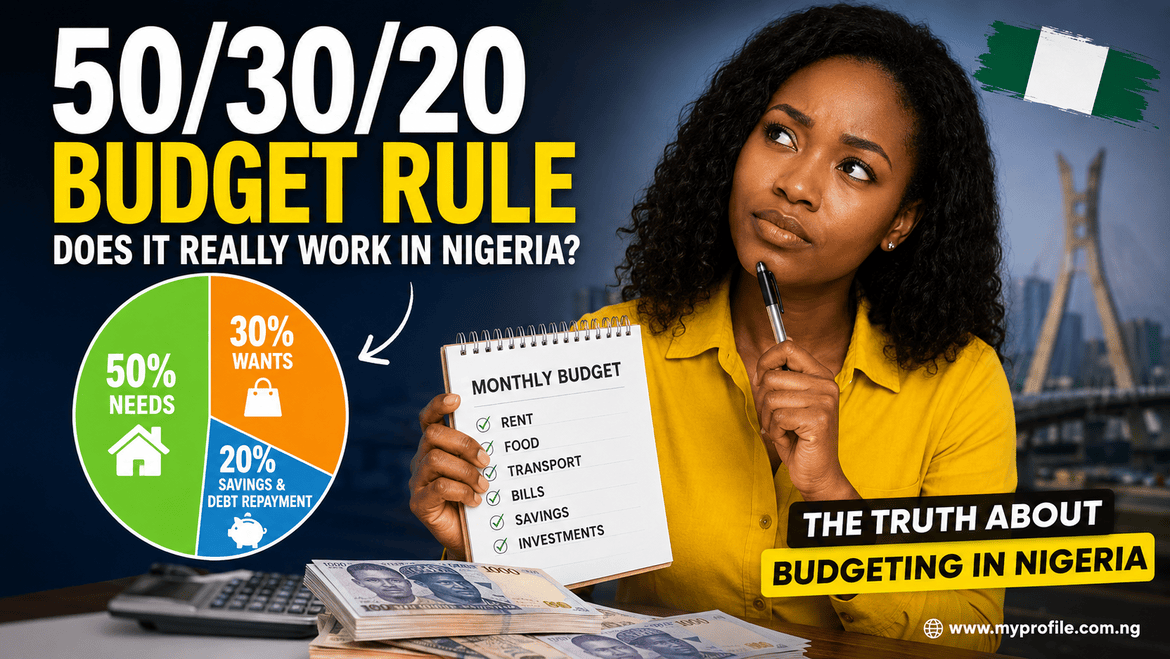
If you’ve spent any time reading personal finance content online, you’ve probably come across the popular 50/30/20 budgeting rule. It’s simple, easy to remember, and widely recommended by financial experts around the world. But if you live in Nigeria and earn in Naira, you may have wondered: does this rule actually make sense here, or is it just another foreign financial concept that doesn’t translate well to our economy?
This guide breaks down what the 50/30/20 rule really means, whether it holds up under Nigerian economic realities, and how you can adapt it to fit your income and lifestyle.
What Is the 50/30/20 Budget Rule?
- 50% for needs: rent, feeding, transportation, electricity, data, and other essential bills
- 30% for wants: entertainment, eating out, subscriptions, shopping, and other non-essential spending
- 20% for savings and debt repayment: emergency funds, investments, loan repayments, or long-term goals
The idea is that by following this structure, you avoid overspending, build savings consistently, and still leave room to enjoy your money. It’s a popular method because it doesn’t require complicated spreadsheets or financial expertise, just a percentage split.
Why the 50/30/20 Rule Struggles in Nigeria
While the rule is easy to understand, applying it directly to a Nigerian budget often runs into real challenges. Here’s why:
1. The Cost of “Needs” Often Exceeds 50%
For many Nigerians, especially those in urban centers like Lagos, Abuja, or Port Harcourt, basic necessities alone can consume well over half of monthly income. Rent, transportation fueled by fluctuating fuel prices, feeding costs affected by inflation, and electricity (including generator fuel or inverter maintenance) can easily eat up 60% to 80% of a salary, leaving very little for the “wants” or “savings” categories.
2. Irregular or Multiple Income Streams
A large percentage of working Nigerians don’t earn a single, predictable monthly salary. Many combine a day job with side hustles, freelance work, or trading. This makes it harder to apply a rigid percentage-based rule, since income can vary significantly from month to month.
3. High Inflation and Currency Volatility
Nigeria’s inflation rate and the fluctuating value of the Naira mean that the cost of goods and services can change quickly. A budget plan that made sense a few months ago may no longer be realistic today, making fixed percentage rules harder to maintain long-term without frequent adjustments.
4. Limited Access to Traditional Savings and Investment Tools
The 20% savings portion assumes easy access to reliable savings or investment vehicles. While Nigeria has seen growth in fintech apps, mutual funds, and cooperative savings schemes, many people still rely on informal methods like “ajo” or “esusu,” which don’t always offer the same structure or predictability as formal savings accounts.
So, Does the 50/30/20 Rule Work in Nigeria?
The honest answer is: partially, and mostly as a guide rather than a strict formula.
The core principle behind the rule, dividing income intentionally instead of spending without a plan, is still valuable in the Nigerian context. However, the exact percentages often need to be adjusted to reflect local realities. For many Nigerians, a more realistic split might look closer to:
- 60-70% for needs
- 15-25% for wants
- 10-15% for savings and debt repayment
This adjusted version keeps the spirit of the original rule while acknowledging that the cost of living in Nigeria doesn’t always allow for the traditional 50/30/20 split, especially for low- and middle-income earners.
How to Adapt the 50/30/20 Rule for Nigerian Realities
If you want to make this budgeting method work for you, consider these practical adjustments:
1. Start with your actual numbers, not the ideal percentages. Track your real spending for one to two months before assigning percentages. This gives you a realistic starting point instead of forcing your expenses into a formula that doesn’t fit your life.
2. Separate true needs from inflated needs. Some expenses labeled as “needs” may actually have cheaper alternatives, for example, adjusting transportation choices or renegotiating rent in a more affordable area.
3. Automate whatever savings percentage you can manage. Even if you can only save 5% to 10% consistently, automating it through a savings app or standing bank order helps build the habit until your income grows or expenses reduce.
4. Review and adjust monthly. Given inflation and currency fluctuations, a Nigerian budget should be treated as a living document, reviewed and adjusted every month rather than set once and forgotten.
5. Factor in irregular income. If you have variable income, consider budgeting based on your lowest expected monthly earning, and treat any extra income as a bonus that goes toward savings or debt repayment.
Final Thoughts
The 50/30/20 rule wasn’t designed with the Nigerian economy in mind, and applying it rigidly can leave many people feeling like they’re failing at budgeting when the real issue is that the framework doesn’t match local income and cost-of-living realities. That said, the underlying principle, intentional allocation of income into needs, wants, and savings, is still a useful mental model.
The key is flexibility: adjust the percentages to reflect your actual expenses, prioritize consistent (even if small) savings, and revisit your budget regularly as prices and income change.
Frequently Asked Questions (FAQs)
1. Is the 50/30/20 rule realistic for someone earning minimum wage in Nigeria? For minimum wage earners, the “needs” category often exceeds 50% due to the high cost of transportation, feeding, and housing. A modified split with a higher needs percentage and a smaller savings goal is usually more realistic.
2. What is a better alternative to the 50/30/20 rule for Nigerians? Many financial advisors suggest a flexible approach, such as 70/20/10 or even 80/15/5, depending on income level, then gradually shifting toward the traditional 50/30/20 split as income increases.
3. How much should a Nigerian save every month? There’s no fixed amount that works for everyone, but financial experts generally recommend saving at least 10% of your income, even if it’s a modest amount, and increasing that percentage as your income grows.
4. Does the 50/30/20 rule account for Nigeria’s inflation rate? Not directly. The rule assumes relatively stable prices, so in a high-inflation environment, budgets need to be reviewed and adjusted more frequently than the rule originally intended.
5. What budgeting apps can help Nigerians track the 50/30/20 rule? Several Nigerian-friendly finance apps allow users to track income and expenses in Naira, categorize spending, and set savings goals, making it easier to monitor how closely your spending matches your intended budget split.